Articles

AFRICAN CICHLID ARTICLES

African Cichlids and Plants

Keeping African Cichlids in Harmony

Lake Victoria Cichlids

Malawi Cichlids

Reducing African Cichlid Aggression

Why African Cichlids


AQUARIUM CARE ARTICLES

A Primer on Water Chemistry

All you Ever Wanted to Know about Water Hardness

Aquarium Aeration

Aquarium Filtration

Aquarium Maintenance and Water Quality

Aquarium Medications, Treatments, and How They Work

Caring for Your Fish While You Are Out

Controlling Algae by Controlling Phosphate

Do I Need a Quarantine Tank?

Healthy Fish Tips: 5 Easy Ways to Keep Your Fish Healthy

How to Properly Maintain your Aquarium

Old Tank Syndrome

Recycling a Used Aquarium from a Garage Sale

Repairing a Leaky Aquarium

Simple Tips for a Healthy Aquarium

Summer Health Tips for Aquarium Fish

Tackling Aquarium Algae Problems

The Energy Efficient Aquarium

The Science of pH

Thoughts on Aquarium Equipment Maintenance


AQUARIUMS HELPING PEOPLE

Aquariums for Insomniacs


AQUATIC PLANTS ARTICLES

Aquatic Plant Health

Aquatic Plant Propagation

Designing a Planted Aquarium

How to Make a Moss and Shrimp Planted Aquarium

Photosynthesis and Respiration in Aquatic Plants

Tropical Aquarium Plants for Beginners


BEGINNER ARTICLES

A Primer on Fish Foods

Aquarium Glossary and Internet Glossary

Aquarium Tank Basics

Buying an Aquarium

Buying and Introducing Fish

Buying New Fish

Freshwater Community Tanks for Newbies

How Filters Work

How to Set up a Freshwater Aquarium (Fish Tank)

Selecting Your First Fish Tank

Start your Aquarium with Success

Ten Tips for Selecting an Aquarium Store

The Ten Commandments of Fishkeeping

Tips for Cycling Your New Aquarium

Tropical Fish Species for Beginners

Twelve Quick Aquarium Tips for Beginners

Why Fish?


DECORATION ARTICLES

Aquarium Decoration

Decorating Your Aquarium

How to Determine the Amount of Substrate Needed for an Aquarium

Making Your Aquarium Look Like Home


FISH BREEDING ARTICLES

Betta Splendens: General Information and Breeding

Breeding Crayfish

Breeding Gouramis

Breeding Kribensis Successfully

Breeding Oscars

Breeding Tetra Fish Successfully

Guppy Breeding for Experts

Mouthbrooding 101

When and How to Strip African Cichlid Eggs: Step by Step How to Instructions


FISH DISEASES ARTICLES

Dropsy

Fin Rot

Fungal Infections of the Mouth

Fungus (Saprolegnia)

Hexamita

Hole in the Head disease (HITH)

Swim Bladder Problems

Symptoms and Treatments of Common Fish Diseases

Tuberculosis

Velvet or Rust


GENERAL CICHLID ARTICLES

Your First Cichlid Aquarium


GOLDFISH ARTICLES

Buying Your Goldfish Aquarium

Fancy Goldfish Types, Varieties or Breeds

General Care of Goldfish

How to Breed Goldfish


INVERTEBRATE ARTICLES

Freshwater Snails


MARINE FISH ARTICLES

Beginning Saltwater

Marine Species NOT For The Beginner


NATIVE FISH ARTICLES

Successfully Spawning and Raising the Green Sunfish (Lepomis cyanellus)

The Native Aquarium


NEW WORLD CICHLID ARTICLES

All About Oscar Fish

Convict Cichlid

Firemouth Meeki Information

Good Tank Mates for Oscars

How to Determine the Sex of Discus Fish

Oscar Care Basics

You Can Keep Discus Too!


POND CARE ARTICLES

All About Dissolved Oxygen

pH Explained

Pond Water Chemistry


TERRARIUM ARTICLES

Hermit Crab Cages


TROPICAL FISH ARTICLES

A Primer on Tropical Fish Families

Betta Splendens: Caring for your little fighter

Choosing Shoaling Aquarium Fish

General Cichlid Information

Green Spotted Puffer Profile

Guppies 101

How to Increase Your Fishkeeping Fun

Miniature Aquariums

Myths About Goldfish Bowls

Ten Tips for Caring for Your Betta Fish

The Pictus Catfish: The Fish That Needs A Shave?!

What Exactly are Plecos?


Reef Time
Need DIY reef tanks, fish or corals information?


Parrot Cichlids
Learn About the Unique Parrot Cichlid at ParrotCichlids.com


Parrot Cichlids
Labrador Retriever wallpapers, training, ownership, care, health and puppy information


  Photosynthesis and Respiration in Aquatic Plants

View printer-friendly version


.


Before we discuss the techniques and equipment necessary to maintain healthy aquarium plants, let us look briefly at the fundamental processes that take place in living plants.

Plants range in structure from simple unicellular algae to complex higher plants composed of many different types of cells adapted to perform different functions. Thus, the roots, stems, branches, leaves, flowers and fruits all play their part in maintaining the whole plant. The two most vital processes that occur in all green plants, whether simple or complex in form, are photosynthesis and respiration.

Photosynthesis

As the term suggest, this is a building up process that is 'powered' by the energy of light. During photosynthesis, carbon dioxide is absorbed and oxygen liberated. These gases enter and leave the plant throught tiny pores called stomata. Inside the plant cells - principally in the leaves - carbon dioxide and water are chemically combined in the presence of light and the green pigment chlorophyll to produce simple sugars, such as glucose. Although still imperfectly understood, the process can be simply expressed in the following equation:

            6CO2 + 6H2O  --------->  C6H12O6 + 6O2

The formation of simple sugars is quickly followed by other reactions that convert sugar into starch. Oxygen is produced as a by-product.
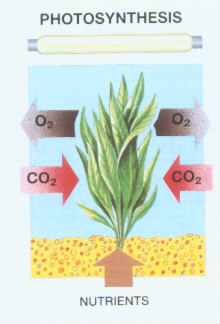
Photosynthesis Illustration

Photosynthesis is most active in the blue and red portions of the light spectrum, a factor to bear in mind when providing effective aquarium lighting. It is the chlorophyll that absorbs these wavelengths to energize photosynthesis, although only about 3% of the light falling on a leaf is absorbed and used in this way.

Chlorophyll is really a mixture of two green pigments: chlorophyll a and chlorophyll b. Other plant pigments, such as carotene (orange) and xanthopyll (yellow), are masked by chloropyll in green plants and are responsible for the striking patterns of variegated ones. They take no part in photosynthesis. A plant grown in the dark loses its chlorophyll, allowing other pigments to give it a sickly yellow 'etoliated' appearance.

For chlorophyll to form in the leaves a plant must have access to iron, hence the importance of providing sufficient iron in the substrate. Plants lacking iron - said to be 'chlorotic' - assume a similar yellow or pale green appearance to etoliated plants, although the causes are quite different in the two instances.

The intensity of illumination, the supply of carbon dioxide and the temperature of the surroundings all affect the rate of photosynthesis. Between 0oC and 25oC (32-77oF), a rise of 10oC (18oF) effectively doubles the rate of photosynthesis. Similarly, a high concentration of carbon dioxide coupled with a high light intensity also produces a significant increase in photosynthetic activity. Thus, introducing carbon dioxide into the aquarium in carefully controlled amounts can boost plant growth in well-lit tanks.

Respiration

In simple terms, respiration is the reverse of photosynthesis. It is the process by which food substances are broken down in the presence of oxygen to liberate energy, principally as heat. Carbon dioxide is produced as a by-product. Respiration takes place in all plant cells and continues irrespective of light. Thus, during darkness - when photosynthesis ceases - respiration accounts for the net absorption of oxygen and the liberation of carbon dioxide from the plant.

Respiration Diagram


Aquariumrank.com - Ranking the Top Aquarium Sites on the Internet   Fish Topsites    Hobby Rank - The Coolest Hobby Sites on the Internet