View printer-friendly version
|
|
. |
Problem wtih algae
Every aquarium is at some time or other troubled by infestations of algae. What are algae? Where do they come from? How can they be tackled without harming the other plants and the fishes in the aquarium? These are questions that most fishkeepers have asked, perhaps in desperation, at some stage in their lives. Here, we try to provide some answers.
What are algae?
Botanically, algae belong to the division of the plant kingdom known as the Thallophyta, which they share with fungi. Algae are comparatively simple plants that range in form from microscopic unicellular types to gigantic seaweeds that may reach a length of 70m (230ft) in the oceans of the world. Our concern, however, is with the smaller end of this size range.
Important factor contributing to the tenacity and widespread distribution of algae are their incredible reproductive capacity and their ability to survive in a viable state (either in the plant form or as spores) in difficult environments and over long periods of time. Many species of algae can exist in a seemingly desiccated state for many years and their spore can be carried on air currents through the upper atmosphere to encircle the globe. In spite of the heat, cold and radiation, such spores may germinate successfully on their return to a favourable environment after a period of several years.
Although there are species of algae that grow on tree-trunks, on rocks and a damp soil, it is in water that they exist in greatest numbers and variety. Algae have adapted to grow in all types of water: flowing and stagnant; salt and fresh; warm and cold; clean and badly polluted. In the aquarium, they may be found floating on the surface, suspended in the water, or growing in a tangled mass on rocks, plants, gravel or tank equipment. Sometimes, the only indication of their presence is when the water turns green.
The algae most likely to trouble freshwater aquarists fall into the following groups:
Green algae
This class contains a large proportion of the types encountered in freshwater aquariums. In these algae the green pigment chlorophyll is not masked by other pigments, as it is in other groups.
The unicellular green algae are not visible individually to the naked eye, but appear as a green cloudiness in the water when present in vast numbers. Typical examples are Chlamydomonas and Chlorella, which forms a green film on the aquarium glass. Multicellular 'colonial' green algae, such as Volvox, Scenedesmus and Pandorina, also cause 'green water'.
The filamentous green algae, in which the individual cells are arranged end to end in long chains, cause frequent problems in aquariums. They may occur as a tangled mass, as in Spirogyra, or as green strands attached to rocks and plants, as in Oedogonium and Vaucheria.
Diatoms
Characterized by their silica-impregnated cell walls, diatoms are an important part of the plant plankton that floats in the oceans and in fresh water. Diatoms can proliferate in freshwater aquariums when the levels of phosphate and nitrate are excessively high. They form a brown slime on the gravel, rocks and tank glass, and can even discolour the water in heavy infestations.
Whip algae
As their name suggests, the unicellular species in this group have flagellae, or tiny whips, to propel themselves through the water. (In fact, they are on the borders of being classed as unicellular animals, or Protozoa, rather than plants.)
Whip algae rarely cause problems in aquariums because they thrive in such high nitrogen levels that once they begin to proliferate everything else in the tank will have undoubtedly died in the heavily polluted conditions.
Blue-green algae
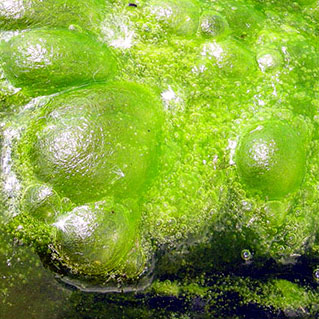
These organisms share many characteristics of both algae and bacteria, and are now placed in a separate category of their own. In the aquarium they appear as dark green gelatinous sheets that creep over rocks and plants until, unchecked, they can smother everything in the tank. They thrive in bright light and high nitrate and phosphate levels, in both acid and alkaline water. They can produce toxins that are lethal to aquarium fishes.
How do algae reach the aquarium?
In real terms, it is impossible to stop algae reaching the aquarium. As we have seen, the air is filled with algal spores that will germinate on reaching a suitable body of water- including the home aquarium. Algae or algal spores may also be introduced on new plants, snails and even in the faeces of new fishes. Tank furnishings and equipment will also carry algae when moved from one aquarium to another
The causes of excess algal growth in the aquarium
Once present in the aquarium, algae will grow to excess in fairly well-defined conditions. The most clear-cut cause of excess algal growth is exposure to sunlight; the relative brightness and wide spectral 'richness' of sunlight spur algae to 'bloom' into life.
The same effect occurs, although less markedly, if the artificial illumination in the aquarium is to bright or left on too long. Too low a density of aquarium plants can also allow algae to grow unchecked in the aquarium. And high levels of nitrates, phosphates, sulphates and carbonates act as nutrient 'fuel' to such expansion.
The control of algae
Based on the above cause, the basic strategy for controlling algal growth clearly revolves around the level of light given to the aquarium. But there are many ways in which aquarists can keep algae in check. Try the following useful tips:
- Ensure that the aquarium is not exposed to sunlight.
- Install lights of the correct type and power rating
- Illuminate the aquarium for only 10 hours a day.
- Keep the aquarium well planted
- Once the underwater plants are thriving, introduce floating aquarium plants to deter the growth of algae. Ceratophyllum sumersum and Riccia fluitans are idea for this purpose.
- Inspect all rocks, plants, snails, etc., for algal filaments and sterilize as necessary.
- Consider introducing algae-grazing fishes, such as Hypostomus sp. (Suckermouth Catfishes) and Gyrenocheilus sp.
- Carry out regular partial water changes to keep the level of nitrates, etc., down to acceptable limits.
- Use a good algicide if none of the above measures makes any improvement. Algicides are available mainly as liquid preparations; dose the aquarium water as instructed by the maker. Avoid overdosing.
|