View printer-friendly version
All too often, we see this little sight on the cover of a package for a “bowl kit” at a pet store or in the bedroom of a child: a small goldfish, or group of goldfish, swimming around in circles in a little gallon or half gallon bowl. Many of us who have never kept fish before assume that the fish is fine and will live out its full life in this container… maybe a bit cramped as far as living space goes, but otherwise a healthy environment for a fish at a good price for the owner.
However, ask any experienced breeder of goldfish or expert on the species, and you will hear a vastly different story. You may be surprised that ALL goldfish (including the fancy varieties) will grow to a minimum of half a foot long (with comet and “common” varieties reaching close to a foot), and have life expectancies that rival many decades long. Some of the longest documented cases have been recorded by Chinese emperors, who have owned prized goldfish that lived over 40 years (sometimes outliving them!). The average lifespan, according to the Encyclopedia Brittanica, is 25 years in the wild, and I have seen firsthand or personally raised goldfish that exceeded 15 years easily in captivity. However, most goldfish lives are sadly shortened by well-meaning but misinformed owners, who kept them in bowls and believed they died of “natural causes” after a few short years.
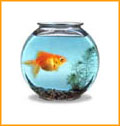
Why are bowls all that bad, you may ask… my child won this fish at a fair or I bought it for a few cents as a feeder from a pet store, and I’m not looking to give it deluxe accommodations, for God’s sake! However, as pet owners, we should have a higher standard than just having our pets barely survive for a short period of time to decorate the coffee table or entertain a child for a few days. Our pets are living creatures that depend on us for an environment that will at least provide the minimum requirements to keep them healthy. A bowl for a goldfish does not, for several reasons:
1) Goldfish produce more ammonia than other fish per unit mass because they are relatively inefficient eaters. This is a toxic product of fish waste decay (you may have noticed that goldfish cloud water faster than many other species) that will quickly pollute Goldie’s bowl and even frequent water changes will not be able to keep up with this. Not only will these wastes poison your fish directly, but they will stress them over time, reducing their natural immunity and making them more susceptible to disease. Smaller containers are inevitably more difficult to maintain balance in over time, and get dirtier faster, compounding this problem even more.
2) As mentioned, all varieties of goldfish grow to over six inches as adults (I’ve personally seen black moors and lionheads the size of small koi!). Some disreputable fish stores will try to convince you that they have different size varieties, but in truth, what this comes down to is age grades, since most fish are sold as juveniles. Chances are, if you buy a small goldfish, it will be a juvenile (grown specimens cost big $$!). If you see a goldfish that has been living in a container for more than a few years and it is only 2”, it is severely stunted! All fish give off pheromones, which limit their own growth in a closed environment, an adaptation that helps partition off limited natural resources in the wild.
3) Goldfish are a coldwater species, and thus evolved to need more oxygen than tropical fish (more gases can dissolve in cold water than the same volume of warmer water). No bowl or small container will provide enough, even with an airstone!
4) Most bowls do not allow room for a filter or apparatus to circulate water. Thus, the "good" bacteria which promote proper cycling can't really grow in a bowl to appreciable numbers, because they are mostly aerobic species. Toxins accumulate, making the situation, already bad, much worse.
For these reasons, without even going into ethics or swimming room arguments, THE ONE INCH OF FISH PER GALLON GUIDELINE THAT APPLIES TO SMALL TROPICAL FISH DOES NOT APPLY TO GOLDFISH. In fact, the consensus among many experienced goldfish owners is that they need a MINIMUM 10 gallons per fish. This is actually just a bare minimum for smaller specimens (juveniles to young-adults, mostly), and full-grown adults really should be given even more. This idea may sound shocking to many new to the hobby, some which may have even been told that “bowls are fine” by pet store employees, but please don’t take my word for it, consult Aquarium Fish Magazine, any number of other hobbyist journals, or recently published books on goldfish.

Photo courtesy of Kimberly Lucas
This photo really does illustrate well their potential size in good conditions--and "Red" isn't even close to full-grown, he's only about 2 or 3 years old!
Measuring tape shown with 2" mark anchored at left corner; fish is a bit angled with respect to the camera and may actually be slightly bigger than he appears here.
In my opinion, the myth that goldfish can do just fine in bowls is perpetuated by a number of factors:
1) Goldfish, especially the “common” varieties, are a hardy species, living through a lot of very bad conditions without going belly up. Just because they can live through it in the short term, however, does not mean that they are thriving or healthy… after all, fish can’t talk to us, so sometimes the first sign of illness is already too late. In addition, most people think that a lifespan of 2-3 years sounds normal for a fish, and don’t become suspicious of anything except natural death when their goldfish dies.
2) Goldfish are the oldest bred ornamental fish. They were around long before any serious research was done into fish biology or ecology, although the royal elite in Asia prized them a great deal and went to lengths to care for them in large outdoor ponds.
3) Goldfish are one of the cheapest fish available at the store, and it is easy to purchase a feeder for a dime. Monetary value, however, is no excuse to me for mistreating a living creature. I also don’t buy the “I saved it from certain death as a feeder” excuse… predation is a natural way of limiting population growth and usually humane; a drawn-out death from slow poisoning, overcrowding and stress is not. If you are going to keep a pet and bring it into your home, do it right, and be prepared to provide it with a life worth living.
4) Not all pet stores are full of conscientious or well-informed staff. It’s often much easier to make a quick sale of a bowl kit, which is cheaper and more accessible, than spend time explaining the more costly sale of a whole tank setup, sitting down with the potential customer to patiently teach water chemistry principles. Goldfish bowls often target impulse shoppers who just want something pretty to entertain themselves with.
This being said, I hope I’ve changed your mind about that seemingly harmless little goldfish bowl setup. About the only fish suitable for keeping in a bowl is the betta, or Siamese fighting fish, which can breathe air directly by way of a structure called a labyrinth. Even then, a bowl as a home is a stretch, because bettas (unlike goldfish) are tropical (need to be kept at a nonfluctuating temperature above 74F) and need to be given good water quality to live well (more difficult to maintain, the smaller the environment).
If you already have a bowl, it is not too late to purchase a cheap tank setup and give your pet the room it deserves... it may just surprise you when Goldie doubles in size in a few months.
|