View printer-friendly version 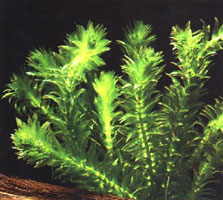 Plants multiply in two basic ways; sexually and asexually. Sexual reproduction involves the production of spores or seeds that germinate to form new plants. Asexual reproduction embraces a number of vegetative processes by which new plants are produced from various parts of the parent plant. Man has harnessed these entirely natural processes, and extended or adapted them in some cases, to develop a number of reliable propagation techniques that can be applied to a wide range of land and water plants. Here we look briefly at the propagation techniques commonly used with aquarium plants.
Sexual propagation techniques
Sexual reproduction in plants relies on the fusion of male and female sex cells, the gametes, to form a zygote. In lower plants, such as algae, mosses, liverworts and ferns, zygotes develop into spores. In the higher plants, such as herbs, shrubs and trees, the zygotes ripen into seeds. In both types of plants, the genetic make-up of new plants is influenced by the characteristics of their respective 'parents'. Thus, only in sexual forms of propagation can change be introduced into succeeding generations.
Man uses this opportunity for variation to the full in horticulture, improving and molding the characteristics of many plants to suit new conditions or to produce new strains with bolder flowers or heavier crops. In the world of aquarium plants, sexual propagation techniques play a relatively small role compared to the important part played by asexual methods. The lower order plants are seldom propagated by sexual techniques and among the higher plants it is aquatic species destined for pool use rather than aquarium plants that are reproduced in this way. But since the aim is usually to produce better and more colourful blooms - a factor which has no bearing on aquarium culture - it is easy to see why comparatively little experimentation has been attempted with the majority of aquarium plants.
Nevertheless, there are certain aquarium plants that can be usefully propagated by sexual techniques. In order to produce seeds, the plants must first produce flowers. And here we can make a reasonable distinction between aquarium plants that readily produce flowers and those that need a little coaxing.
In the first group we can include deep marginals, such as species of Aponogeton and the water lilies (the latter suitable in aquariums only as young plants), that grow from a rootstock embedded in the bottom soil. These plants produce leaves and flowers that float on the surface. Pollinated largely by insects, the flowers set seeds and these germinate readily in the substrate.
Most aquatic plants fall into the second category. These were once land-living species that have colonized water relatively recently in evolutionary terms. They still retain their ancestral habit of producing flowers and seeds, but only when then water level falls low enough for them to grow emersed. Therefore it is unlikely that these plants will flower constantly submerged in an aquarium. In this group we can include most Cyptocorynes and species of Echinodorus, Hygrophila and Ludwigia.
With perhaps only half a dozen species is seed the regular mode of production on a commercial basis. These include Samolus parviflorus, Echinodorus berteroi and Ludwigia sp. The technique used under greenhouse conditions is as follows. The level of the water in which the plants are growing submersed is gradually allowed to fall. This stimulates the plants to produce stiffer aerial leaves and then flowering shoots. Leaving the vents open in the greenhouse allows insects to cross pollinate the flowers in a totally natural way. The ripe seed is then collected and sprinkled over the surface of shallow pans of sowing compost. Normally, seeds germinate quickly, but in some species germination may be delayed for several weeks or even months. The soil in the pans is kept just moist until the seedings have reached at least 10cm (4in) or so high. The pan is then flooded with water and soon after the plants transferred to their permanent quarters.
This technique can be used in the aquarium where the opportunity exists. As an alternative to insect pollination of the flowers, use a fine paint brush to transfer pollen from the stamens to the stigmas. Do remember that the resulting seeds have no storage life at all and must be sown immediately.
Asexual propagation techniques
Asexual techniques are widely used in commerce and in the hobby for reproducing aquarium plants. The methods involved range from simple division to the complex realms of tissue culture, although the latter is strictly a commercial process. Here we review these methods.
Runners
Most aquarium plants produce outgrowths called runners. These elongated shoots arise form leaf axils (i.e. the junction of a leaf and the stem) on the side shoots, but occasionally from the apical shoot. They either run along the surface of the substrate, as in Vallisneria sp. and Echinodorus tenellus, or grow underground for a while before pushing up to the surface, as in the Cryptocorynes. A baby plant, usually called a slip, develops at the tip of each runner. When this has put roots down into the substrate and become established, it also produces one or more runners. And so the aquarium quickly becomes colonized by new plants in this way.
It is best to allow each baby plant to develop undisturbed for a time and to reach a few centimeters in height before detaching it from the parent plant. While they can be detached earlier without harm, this may prevent such baby plant from producing runners successfully when they mature. Left to themselves, the connections between the parent and baby plants eventually break down.
Some floating plants, such as Limnobium lavigatum and Pistia stratiotes, also spread rapidly in this way. Each plant produces several runners at the same time.
Offsets
These are new plants produced on outgrowths that are similar to runners but shorter and stouter. Many species of Echinodorus gradually form large clumps by continually producing offsets. To propagate such plants, simply divide the clump into smaller plants and set these in the substrate.
Rhizomes
Rhizomes are underground stems that superficially appear rootlike, but can be identified as stems by the presence of scalelike leaves and buds. They serve not only as food storage organs to tide plants over during dormant periods but also as a natural means of asexual reproduction.
Many aquatic plants grow from rhizomes. These include Acorus gramineus, Nupharsp. and Nymphae sp. To propagate these plants, simply cut or split the rhizome into pieces and each piece will develop new shoots and roots. In some plants, the rhizome branches freely and thus is ideal for propagation in this way. Conversely, certain species of Aponogeton grow from a storage organ - called a tuber - that scarcely branches at all and has just one growing tip. Cutting this to try and propagate it will kill the plant.
Adventitious shoots
As the name suggest, these are plantlets that arise from any organ of the mother plant. There are countless examples of adventitious shoots developing on aquarium plants. The floating form of the Indian Fern, Ceratopteris thalictroides, produces hundreds of tiny ferns at the leaf margins. Eventually, these detach and float away to grow independently. Plantlets also develop on older leaves of submerged specimens. Java Fern, Microsorium pteropus, develops into large colonies by reproducing itself in the same way. In this case, the young plants attach their roots to stones or bark close to the mother plant.
Nymphaea daubenyana, a water lily from West Africa, produces tiny water lilies from the center of the floating pads. Eleocharis vivipara produces new plants on the tips of the leaves. In emerse-grown plants, the tips naturally bend over and enable the plantlets to put out roots where they touch the ground. Thus, vast colonies of this plant are formed in a very short period of time. If left separated on submerged specimens, several tiers of rosettes may develop one on top of another.
Adventitious plantlets are produced on the flowering stems of many aquarium plants, including certain species of Echinodorus, such as E.cordifolius, E.paniculatus and E.parviflorus. Simply peg these stems down and separate the plantlets when about 15cm (6in) high.
Cuttings
Taking cuttings is a familiar technique for propagating many houseplants and garden plants. In many ways, taking cuttings of aquarium plants is even easier. Cuttings taken from land plants are in danger of drying out before roots are formed; being constantly bathed in water, cuttings of aquarium plants are not at risk in this way. In fact, the vast majority of aquarium plants supplied by retail outlets are in the form of top cuttings, i.e. taken from the top section of the plant, including the growing tip.
Cuttings can also be taken from side shoots and from middle portions of the plants. And, of course, the original part of the plant remaining after the cuttings have been taken will usually sprout again. In most species, roots form only at the nodes. In some plants, however, such as Nomaphila Stricta, internodal roots are produced in great abundance.
Take cuttings using a sharp knife or secateurs, or merely tear away a suitable side shoot with a piece of nodal tissue attached. Ideally, each cutting should have two or three nodes, although even single nodes can succeed. If the cuttings are to be grown emerse, remove the lower leaves and dip the base in a fungicide to prevent 'damping off'. Dipping the cutting into hormone rooting powder will help roots to form more quickly,. Insert the lower third of the each cutting into moist growing medium and keep them in humid conditions.
Many plants, such as Egeria sp., Myriophyllum sp., Ludwigia sp. etc, will produce new roots if stem cuttings are simply left to float in the aquarium water. Once roots have formed, insert them into the gravel and anchor them securely until the roots take a goods hold. Cuttings may also be taken from leaves, as in Synnema triflorum, or even from pieces of rootstock in other species.
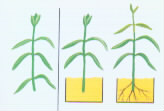
Top cuttings
Since it contains the active growing point, the top section of a plant usually makes a very reliable cuttings. Once separated, simply remove the lower leaves from the cuttings and insert the severed end in the gravel. Roots will develop and the shoot should grow away strongly.
Middle shoot cuttings
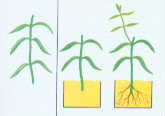
Although it will take longer to establish, the middle portion of a plant will normally succeed as a cutting. Success depends not only on roots developing but also on the emergence of a side shoot from the axil of a leaf. If grown emersed, dip the cut end in a hormone rooting preparation to speed rooting.
Basal portion
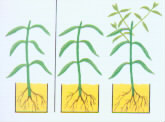
No part of a plant is wasted when cuttings are taken. Left undisturbed, the basal portion should produce side shoots from buds in the leaf axils. These will become the new growing points and will create a bushier plant, the principle on which pruning for shape is based. Many aquarium plants benefit from being pruned to keep their growth in check.
Tissue culture
This is a well-established technique for the rapid multiplication of disease-free stock of trees, shrubs and herbaceous plants. It is also used where the amount of plant material available is limited, as in a new or rate species. Its current experimental use for aquarium plants centres around those species - certain Crytocorynes, for example - that increase only slowly by other methods. Basically, it involves taking minute amounts of tissue from a plant and culturing it on nutrient jelly under strictly controlled sterile conditions. Thousands of plants can be produced in this way in a very short time. It is a very expensive process to set up, however, and is strictly a commercial endeavor that will be applied only to rate and expensive subjects, such as hybrid water lilies, for the foreseeable future.
|