View printer-friendly version
|
|
. |
Just like your cats, dogs, birds, and reptiles, fish can get diseases too. One of the disadvantages of having a sick fish is that the diseases often transmit through the water. To prevent this most people who deal with fish, especially with lots of fish, keep a quarantine, or hospital tank ready at all times. A quarantine tank should have a filter such as the one you have in the main tank. Preferably not an underground filter. There should be no gravel in the quarantine tank. Gravel provides a place for germs, bacteria, and other things to build up. During times when your fish are sick, you want their temporary home to be clean and simple. Most people do add something for the fish to hide in such as a broken pot decoration...Make sure that it's specially made for aquariums. Real pots will contaminate your tank further causing your fish to become sicker. In the case that your fish does become sick put into your hospital tank. Make sure that the hospital tank has been cycling for at least 2 weeks. While the hospital tank is occupied do regular tank cleaning and water changes like you would with the main tank. This will prevent ammonia from building up in your water. Below are a list of common illnesses or diseases that your goldfish could possibly contract. Even some of the most cautious fish owners' fish get sick so don't take it personally. The information below will help you to notice when your fish get sick and what you can do about it...
1.) Ick - At one point in your fish's life you'll probably have to deal with Ick, or Ichtyopthirius. Which ever you choose to call it, these little lice like parasites will attach themselves to your fish causing irritation and extreme discomfort. They will reproduce inside your tank and the young will attach themselves to your fish eventually killing your fish. Like most harmful things, Ick is always in your tank. However, stressful times, poor water conditions, and already ill fish all contribute to contracting Ick. This is a very very common illness and so it has a million cures. Different products can be bought all at different price ranges so your best bet would be to go to the local pet shop, tell them your goldfish have Ick and they'll show you what product will work best for your tank.
2.) Anchor Worm - This little bugger will be sticking straight out of your fish. It usually includes a red ring or circle from where it was attached. Symptoms include seeing the actual worm as well as fish rubbing up against objects in the tank in order to dislodge the worm. Treatment can be found in your local pet shop.
3.) Constipation - If your tank has been a little cleaner than usual your fish may be constipated. This is very common because of the goldfish anatomy. Their insides are all bunched up and that can be clogged with food. This is one of the most easily cured illnesses though. A pea or two a day will help your fish clear out. Peas can be fed any time though, not just during times of constipation.
4.) Common Fungus - There are many different kinds of fungus that a fish can contract. Some affect the mouth only and some affect individual parts of the fish's body. Most fungus looks white, cottony, and fluffy. This too can be cured with the right treatment. Consult your local pet shop for more advice.
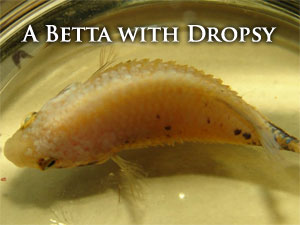
5.) Dropsy - Not all goldfish diseases are easy to treat. In fact the disease known as dropsy is more often than not deadly. Bulgy eyes are the first sign and at that point it is possible to cure. Contact your pet shop immediately!!! Dropsy is a bacterial infection that works it's way through the fish inside out. Symptoms include bloating of the fish as well as scales sticking out in a coarse manner. These signs show during the end of the infection so if your fish has these symptoms, you should probably euthanize it. By that I mean, Put it in a bag of water and place it in the freezer over night. From what I understand this is one of the best and most humane ways to kill you fish.
6.) Fin Rot - Is your fish injured or hurt? Then keep a sharp eye on the affected area because fin rot could easily set in on a wound. Fin rot is caused by a bacteria entering a wound making the already bad situation worse. It's not uncommon for a fungus to grow. This is easily treated with medication. Ask your local pet store for more information on a poduct that will work best for your tank.
7.) Fish Lice - These look like green circle shaped things attached to your fish. It is just another kind of parasite. The fish will rub against objects in the tank to try to get rid of it...The best thing to do is pick them off the fish and then go get some medication quick! If not handled properly, this could result in a fatality.
|