View printer-friendly version
Common - Has a single tail, nothing really special. They are extremely streamline, and that gives them them alot of speed. So don't put these fish with long tailed or slow moving fish.They come in colors of bronze to reddish orange and are sometimes white on the tips of the fins. They can be found in other colors as well. Sadly, these fish are usually used for feeding other animals!
Comet - This fish comes in all sorts of colors with or without white tips. However these have a bit longer fins.
Ryukin - These are much like a fantail, except that they have a distinct hump on their back. They are deep bodied fish and are usually red and white, although they have a wide range in color. I have a red and white ryukin named Macy who is adorable!
Shubinkin (the original) - The Shubunkins are usually a mix of white, red and orange, or blue and black. They also have a single short tail.
Bristol Shubunkin - The same as a the original Shubunkin only these have a longer tail.
London Shubunkin - Now the London Shubunkin Has a single short tail with the same color combinations as the other Shubunkins only these are popular for their intense blue colorings. Not all of them are blue though.
Albino Doll - These have double tails, are fat bodied, and have large telescope eyes.
Fantail - The name says it all, these fish have a double tail that fans out very beautifully. They are plump and fat bodied with pretty much any color combinations. I have an extremely strong, plump, and fiesty fantail named Hiroshi.
Veiltail - This cleverly named fish is known for it's very long double tail. It too is fat bodied. They also come in all sorts of color combinations. These fish are very slow... They are best placed with fish like black moors. Before buying be warned, faster and larger fish are prone to nibble and tear at this fish's nice long tail. It causes much stress to the fish and is unsafe.
Lionhead or Ranchu - These have no dorsal fin but a short double tail. They are fat bodied with a growth or "wen" on their head. Any color combination can be used to describe these fish. However, there is much controversy over the differences between the two fish. But my personal experiences, I'd say that a Ranchu has a much different back shape. The back of a Ranchu usually is rounded at the front into the head, and the top of the back is kinda flat and then near the tail it takes a "dramatic" curve down and kinda flips up at the tail. Lionheads have more of a tadpole shape. Their "chest" and head area are lower than their tail and end half of their bodies.
Oranda - They have a double tail, dorsal fin, and are usually considered fat bodied. They also have a wen. They too come in any color. Most popular is plain orange. I have a calico.
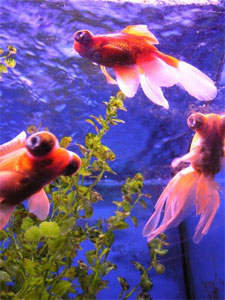
Telescope-Eye - Some of these fish have dorsal fins but some don't. They have a double tail and are fat bodied. They are named after their large eyes which portrude. They've been developed from the veiltails.
Black Moore - My younger sister has a black moor. I kinda wonder why they call them black moors when there don't come in other colors. They are much like an oranda only they have telescope eyes or, eyes which portrude outward. The main drawback of these fish are they are quite blind to start with. They don't compete for food well so they shouldn't be put with faster fish.
Bubble-Eye - Fish like these have double tails, are considered fat bodied, no dorsal fin, large bubbles under eyes filled with liquid. They come in all different colors.
Celestial - These double tailed fish with big, upturned eyes come in all different colors and even silver. Since they have an awkward position for their eyes, they are slow to find food. These fish are best placed with other slow fish.
Pearl Scale - A double short tail, fat body, and protruding scales make up a Pearl Scale. They come in all different colors.
Pompoms - Are doubletailed fish with no dorsal fins. They are usually considered fat bodied fish. They have pompom like growths near their nostrils hence their names.
Wakin - These double short tailed florescently colored fish come in combinations of red, yellow, and white.
Peacocktail - These fish were developed from the watkin. Their tails resemble a butterfly and come in any color combination.
Fringetail - Big double tailed fish with a hump on their backs. They are a fat bodied fish that come in the usual colors.
Jikin - These fish are built like a common and are born completely red, but while they're young, the red scales covering the body are picked off exposing their white skin and leaving their fins and lips bright red which is an awkward sight to see
|