View printer-friendly version No, there is not an error in the title. Of course, when we say “harmony” we mean within some limits – the limits those aggressive fish will permit. I thought of writing this article after a conversation I had some time ago with a petshop owner who was supposed to be specialized in tropical fish. He told me that keeping African cichlids and more specifically “mbuna” never crossed his mind. In his own words – which deeply impressed me : “Those fishes are killers. You get ten of them in a beautiful tank and after two days half of them are dead due to extreme violence”. In a “beautiful tank”… The question is, was it correctly setup for this kind of fishes or was it simply beautiful? No matter what I tried to tell him after that the man had his own opinion – totally convinced that those fishes were simply “killers”. Since I don’t want you to reach the same verdict, I will give you some hints which should be taken into account by everybody thinking of keeping African cichlids.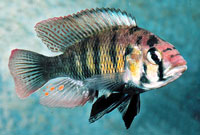
1. The size of the tank: Although the major factor which will tell us which is the right tank size is the final size of the fishes we will choose to keep in it, another – equally important factor – is whether we will be able to form the caves and hiding spots needed for all the fish we plan to keep in it. All the fish should be able to hide in them, not only when juveniles but also when grown up. How can we achieve that ? Simply, by building as many caves as the fish we plan to put in the tank plus some more. Is there a need to build so many caves ? Yes, it is, especially if you plan to keep mbuna, you know, those “killers”.
2. The male / female ratio: The general rule – which I find in most sources – calls for 3 females for every male as the ideal ratio. Those articles refer mainly to the Malawi m’buna, most (almost all – especially the rock fish) cichlids of Lake Victoria and many Tanganyika cichlids. I will disagree with this rule because it didn’t work out for me in 90% of the cases. Almost every species we tried to keep in this way ended up with problems and this includes Pseudotropheus demasoni, Maylandia callainos, Pseudotropheus saulosi, Labidochromis caeruleus “yellow”, Maylandia lombardoi, Tropheus moorii Bemba, Tropheus duboisi Maswa, Cyprichromis leptosoma, Pundamilia nyererei and many more. I would like to note that the only species which started with the male:female ratio of 1:3 and still goes on without any problems is Labeotropheus trewavaae. Is it a coincidence ? It could be but my experience with all those species indicates that the ratio of 1:3 is too low for harem spawners. The reason is very clear. If at any time, for any reason something happens to one of our females (which is not the exception) then the male will be in the same tank with just two females which sounds problems. The problem will be much more serious if we are not in a position to replace the female at once. As an old saying foes “prevention is better than treatment” so we better go for it. This is the reason that we recommend (and we also apply in our tanks) keeping at least five females for every male which belongs to any harem spawning species. Still there are some exceptions to this rule, a notable one being Lam. Callipterus which has been observed in nature at ratios of 1 male : 25 or more females. It is obvious that the rule 1 male : 5 females can’t be used when keeping this kind of species. Thankfully, there are some species that can be kept in pairs or at a ratio of 1 male : 2 females, like Aulonocara species, most Malawi haps, Neolamprologus brichardi etc.
3. Species compatibility: Simply put, this means whether the species we decided to keep in out tanks can stand each other. Sometimes the fish we choose are selected based on their appearance and the beautiful combination they will create in our tank and we don’t pay any attention to the fact that those very same species are “enemies” in their natural habitat. A classic example is Cyphotilapia frontosa and Cyprichromis leptosoma the latter being the preferred meal of the former. Therefore, one needs to do his homework before buying his fishes. Points to be considered are the dietary needs, its natural enemies and general information about the way it lives in nature. Learning all this will help us to select fishes that live at different levels in the lake and will even do so in our tank. As you all know there are fish that stay close to the bottom at all times, some species that will always try to stay near the surface and some other that usually stay between the two. If we select our fishes based on this classification (while still being compatible between them) our tank will see less aggression since there will be less competition for territories and hiding places – the fish will select their places at different levels in our tank.
4. Creating a feeling of stability and security: What do I mean ? I just mean keeping your tank in such a way that will result in the least possible stress to your fish. How to do that ? A very simple yet effective way is to keep a standard tank maintenance routine – after some time you will be almost doing it without noticing. Some points which should be considered are the standard feeding time, the regular water changes (correct water parameters and pristine water quality are a must for your fish), the standard photoperiod, and constant temperature (fluctuating as little as possible). All those elements, when standardized will reduce the stress of your fish and subsequently reduce the aggression in your tank.
5. Prefer younger fish: I have watched many hobbyists preferring to add adult fishes in their tank, a mistake I did myself when I started to keep African Rift lake cichlids. This preference may seem well justified if one thinks of the impressive colors and the personality adult fish exhibit. What we seem to forget is that those individuals have already built a strong character and the more of them we have in our tank the more aggression we will see when they start to fight over territories, females or just hiding spots. Thus, it is preferable to go for juveniles (preferably still not sexually active) so they will have the time to know each other, understand what is “permitted” in their tank and define their territory in it.
6. Less aggressive species are added first: I understand that the classification of the different species according to their aggression is easier said than done, especially in the group of African rift lake cichlids. However, it is of outmost importance to introduce the less aggressive species first in our tanks. This will allow them some time to know their new environment and define their territories without having to suffer from the competition and aggression of other fishes. Under those circumstances, their chances of trouble free survival are maximized. For security reasons, it would be wise to allow them at least one week before adding any other fish.
I am sure that if you follow these very simple steps you will manage to keep those short fused beauties in your tank without any particular problems. No particular problems but a particular personality which will capture your attention many times. This is the main reason that has made this group of fishes so special. After all, it is a matter of character.
|